There’s a simple reason why you can walk into a barbershop with a haircut in your head and walk out with something completely different.
Sometimes, the barber didn’t do a bad job. The haircut might technically be clean, the fade might be blended properly, and the overall shape might look good. But it still isn’t what you wanted.
Why?
You didn’t describe what you wanted clearly enough — and your barber had to guess.
When someone says, “Just take a little off,” “Make it look clean,” or “Do whatever looks good,” those words can mean completely different things to different people.
Your idea of “short” might be an inch off the top. Your barber might interpret it as half an inch. When you say “low fade,” you might imagine a subtle fade that stays close to the ears, while someone else might expect a more noticeable transition.
That small difference in communication can completely change the final haircut.
And if you’ve ever looked in the mirror after a haircut and thought, “This isn’t what I asked for,” there’s a good chance the problem started before the clippers even touched your hair.
The good news is that you don’t need to become a barber or memorize dozens of haircut terms.
You simply need to learn how to explain the four main parts of your haircut: the sides, the top, the back, and the neckline.
Once you know what to say, getting the haircut you actually want becomes much easier.
Read Also : 15 Modern Cornrow Hairstyles for Men: Stylish Ideas to Show Your Barber
Before You Sit in the Barber’s Chair, Know What You Want
Walking into a barbershop without any idea of what you want puts almost all of the decision-making in your barber’s hands.
That isn’t necessarily a bad thing if you completely trust your barber and are happy to let them choose your style. But if you already have a particular haircut in mind, leaving everything open to interpretation can easily lead to disappointment.
Before your appointment, spend a few minutes looking at hairstyles.
You don’t need to save twenty different pictures. In fact, that can sometimes make things more confusing.
Instead, find two or three photos that genuinely look like the style you want.
Pay attention to the details.
Is the fade low, medium, or high?
Are the sides very short or slightly longer?
Is the top textured or smooth?
Is the front pushed forward, to the side, or backward?
Is the neckline natural or sharply defined?
These details matter much more than simply saying, “I want this haircut.”
Think About Your Hair Type Before Choosing a Style
A haircut that looks great on one person may not look the same on you.
That’s because hair behaves differently depending on its natural texture and thickness.
Straight hair tends to fall differently from wavy hair. Curly hair has its own shape and movement. Thick hair may need more weight removed, while fine hair can look thinner if too much is taken away.
So when you’re choosing a reference photo, try to find someone whose hair is reasonably similar to yours.
You should also think about how much effort you’re willing to put into your hair every morning.
If your ideal morning routine is showering, drying your hair, and walking out the door, don’t choose a haircut that requires ten minutes of styling every day.
On the other hand, if you don’t mind using a little pomade, wax, clay, or styling cream, you have more options.
The best haircut isn’t necessarily the one that looks best in a photograph. It’s the one that looks good on you and fits your everyday life.
The 4 Things You Should Tell Your Barber
When you’re explaining your haircut, don’t try to describe everything at once.
Break it down into four simple areas:
- The sides
- The top
- The back
- The neckline
Let’s look at each one.
1. Tell Your Barber How Short You Want the Sides
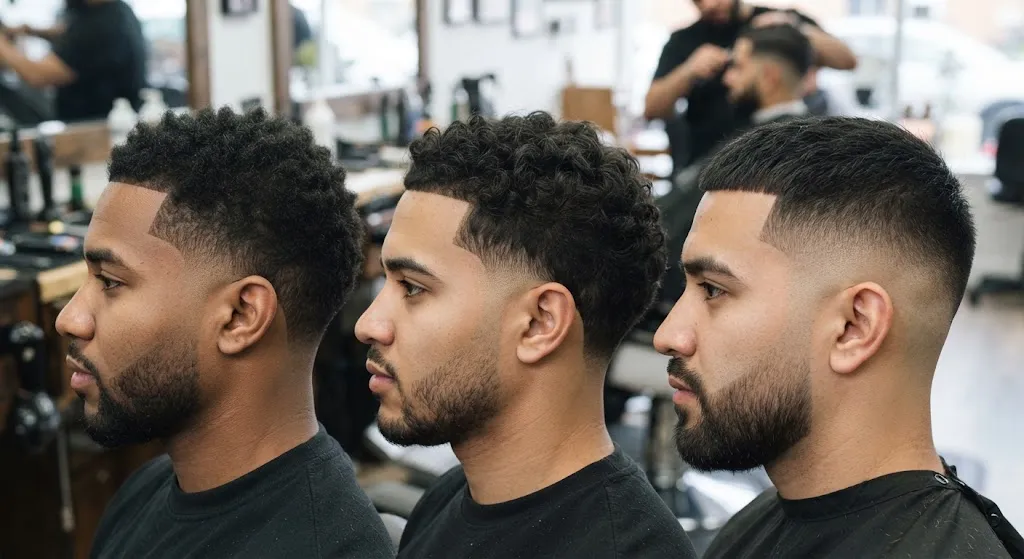
The sides are one of the most important parts of your haircut because they have a major effect on the overall shape of your head and face.
This is where terms like low fade, mid fade, high fade, taper, and clipper guard numbers can be useful.
If you know the clipper guard number you prefer, use it.
For example:
- “Number 2 on the sides.”
- “Number 3 on the sides, but don’t go shorter.”
- “Keep the sides around a number 2 and blend them into the top.”
If you don’t know guard numbers, that’s completely fine.
You can simply describe the result you want.
Try saying:
“I want the sides short, but not down to the skin.”
Or:
“Keep the fade low around the ears. I don’t want it coming too high.”
That’s much clearer than saying, “Make the sides clean.”
2. Explain How Much Length You Want on Top
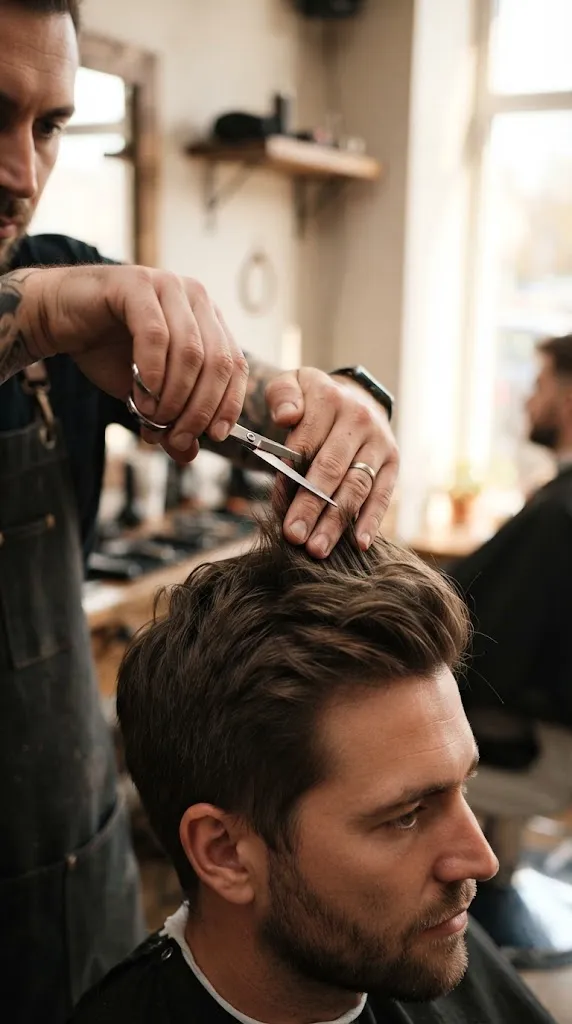
The top is where many haircut misunderstandings happen.
When someone says, “Just trim the top,” the barber still has to figure out what “trim” means.
Are you talking about cutting half an inch?
An inch?
Removing split ends?
Changing the shape?
Or completely changing the hairstyle?
Instead of saying:
“Don’t cut it too much.”
Try something more specific:
“Leave about two inches on top.”
Or:
“Just take a little off the ends. I still want enough length to style it.”
You can also explain what you want to do with the hair.
For example:
“Keep enough length on top so I can push it back.”
Or:
“Leave the front longer because I wear it forward.”
That gives your barber much more useful information.
3. Don’t Forget About the Back
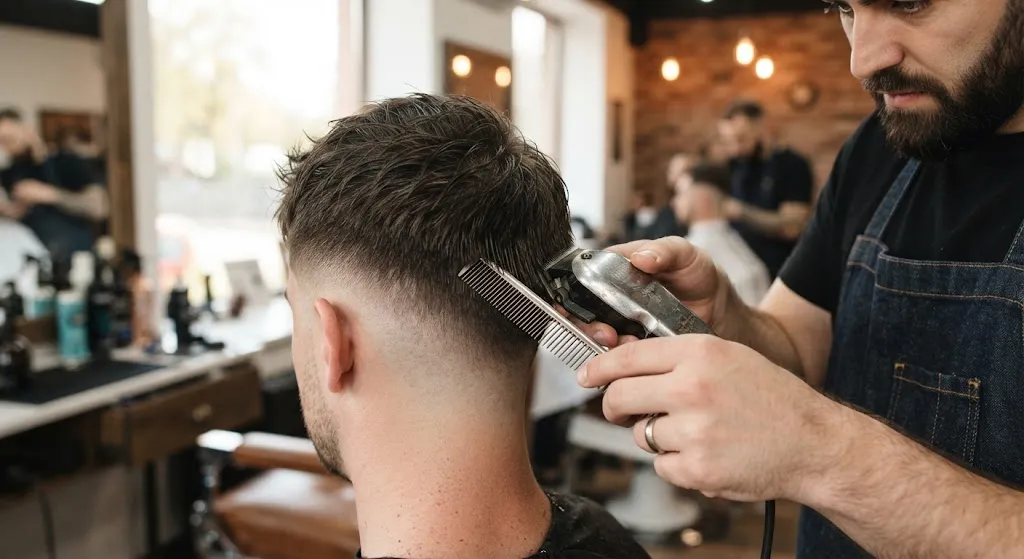
A lot of people focus on the front and sides and completely forget about the back.
But the back can change the entire appearance of your haircut.
You need to tell your barber whether you want the back blended, tapered, or left with a more natural finish.
If you want a simple taper, say:
“Keep the back neat and tapered.”
If you want it blended into the sides:
“Blend the back smoothly into the sides.”
If you prefer a natural neckline:
“Keep the back natural rather than making it too sharp.”
These small details can make a surprisingly big difference.
4. Tell Your Barber What You Want Around the Neckline
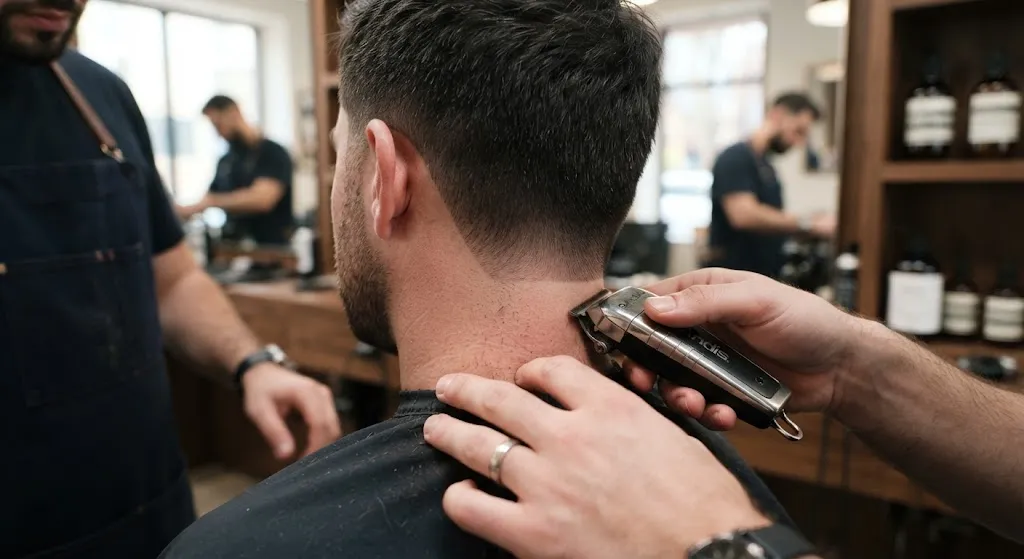
The neckline is one of those details you might not notice until it’s wrong.
Some people like a sharp, defined neckline. Others prefer something softer and more natural.
You might want a square finish, a rounded shape, or a natural taper.
If you want it natural:
“Keep the neckline natural.”
If you want something sharper:
“Give me a clean, sharp neckline.”
If you aren’t sure what would suit you, ask your barber:
“What would look better with the shape of my haircut — natural or more defined?”
That’s a much better conversation than simply saying, “Clean up the back.”
What Should You Actually Say to Your Barber?
You don’t need complicated terminology.
In fact, simple language is often better.
Imagine you’re sitting in the chair and your barber asks:
“What are we doing today?”
Instead of:
“Uh… just clean it up. Keep it kind of short.”
You could say:
“I’d like a low fade on the sides, but don’t take it too high. Leave around two inches on top because I like to style it back. Keep the back blended and the neckline natural. I don’t want too much taken off the front.”
That’s a much clearer instruction.
Your barber now knows:
- Where you want the fade
- How short you want the sides
- How much length to keep on top
- How you style your hair
- What you want at the back
- What you want around the neckline
- What you specifically don’t want
And perhaps most importantly, your barber doesn’t have to guess.
Be Specific About Length
If there’s one thing you should learn from this entire guide, it’s this:
Be specific about length.
Length is one of the easiest things to misunderstand.
“Short” is subjective.
“So much off” is subjective.
“Just a trim” is subjective.
Clipper numbers, approximate measurements, or visual references are much easier to understand
If you don’t understand clipper numbers, don’t pretend that you do.
Simply say:
“I don’t know the guard number, but I want roughly this length.”
Then show a photo.
A very useful sentence is:
“Start a little longer. We can always go shorter.”
That gives you some control.
If your barber cuts your hair too long, more can always be removed.
But once too much hair is gone, you can’t put it back.
Tell Your Barber How You Actually Style Your Hair

Your haircut should work with your routine, not against it.
If you never use styling products, tell your barber.
If you spend five minutes every morning pushing your hair back with pomade, tell them that too.
Tell your barber things like:
“I don’t want to use product every day.”
Or:
“I usually push my hair back with pomade.”
Or:
“I like wearing it naturally and don’t want to spend much time styling it.”
This helps your barber choose a shape that works with the way you actually live.
A haircut shouldn’t only look good for the first ten minutes after leaving the barbershop.
It should still make sense the next morning when you’re getting ready for work, school, or whatever your day looks like.
Don’t Be Afraid to Speak Up During the Haircut
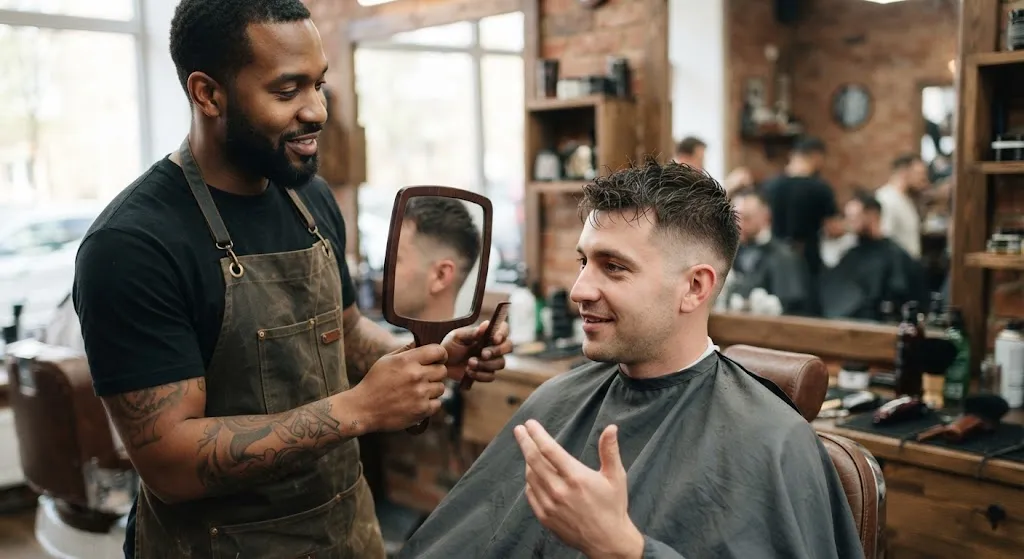
This is something many people struggle with.
You notice the barber is taking more off than you expected.
You see the fade getting higher.
You realize the front is becoming shorter.
But you stay quiet.
Then, twenty minutes later, you look in the mirror and think:
“That’s not what I wanted.”
You don’t need to tell the barber how to do their job.
Just communicate what you’re seeing.
You can say:
“Can we keep a little more length on top?”
Or:
“I’d like the sides slightly shorter.”
Or:
“Can you show me how high the fade is going to go before you take it any higher?”
That’s completely reasonable.
A good barber would rather know what you want during the haircut than discover after the haircut that you’re unhappy.
Mistakes That Can Ruin an Otherwise Good Haircut
Sometimes the barber isn’t the problem at all.
The problem is the communication.
Here are some of the most common mistakes people make.
Saying “Just Clean It Up”
This is probably one of the vaguest haircut instructions you can give.
What does “clean it up” mean?
A tiny trim?
A fade?
Shorter sides?
A shorter top?
A new shape?
Your barber has to decide.
Instead, explain what you actually want.
Saying “Do Whatever Looks Good”
This can work if you completely trust your barber and are genuinely open to anything.
But if you already have an idea in your head, don’t say this.
You’re essentially giving the barber permission to choose the haircut for you.
If that’s not what you want, be more specific.
Not Bringing a Reference Photo
A photo can sometimes communicate in seconds what would take several minutes to explain.
Even if you know the name of the haircut, bring a photo when possible.
But remember: a photo is a reference, not a guarantee.
Your hair texture, density, face shape, hairline, and growth pattern may be different from the person in the picture.
The goal is to show your barber the direction you’re aiming for.
Ignoring Your Natural Hair Type
Don’t expect a hairstyle designed for thick, straight hair to automatically look identical on thin, curly hair.
Your barber can adapt a style to your hair, but you need to have realistic expectations.
Ask:
“Will this work with my hair texture?”
That’s a much better question than assuming every haircut will look exactly like its reference photo.
Once You Get the Perfect Haircut, Don’t Forget It
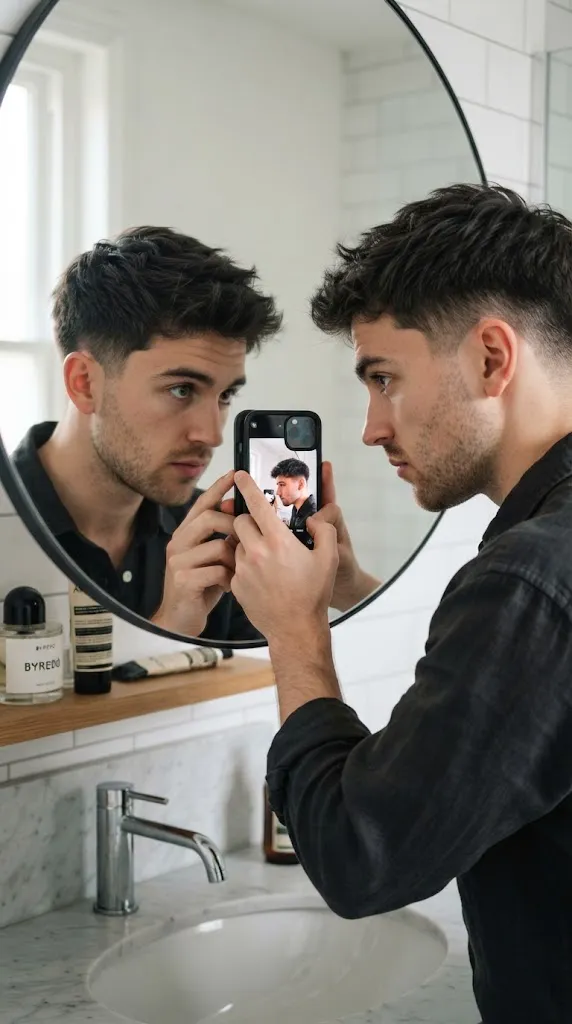
Here’s one of the easiest ways to stop repeating the same haircut conversation every few weeks.
Take pictures.
If you finally get a haircut you love, take clear photos.
Take one from the front.
One from each side.
And one from the back.
You can also write down what you asked for.
For example:
Sides: Low fade, number 2
Top: Keep around 2 inches
Front: Leave extra length
Back: Blended
Neckline: Natural
Next time, you don’t have to remember everything.
You can simply show your barber the pictures and say:
“I want this again.”
That’s about as clear as communication gets.
And if you regularly visit the same barber, this becomes even easier.
Over time, they’ll learn your preferences.
They’ll remember how short you like the sides, how much you prefer to keep on top, how you like your neckline, and how you normally style your hair.
Eventually, “the usual” can actually mean something.
A Simple Haircut Script You Can Save on Your Phone
If you never know what to say when you sit down in the chair, save this template.
“I want [low/mid/high fade or taper] on the sides. Keep the sides around [guard number/approximate length]. Leave about [length] on top because I usually wear it [forward/back/to the side/natural]. Keep the back [blended/tapered/natural], and make the neckline [natural/sharp/square/rounded]. Don’t take too much off the front.”
You don’t have to use every part.
Just fill in the details that matter to you.
For example:
“I’d like a low fade, not too high. Keep the sides around a number 2. Leave enough length on top for me to push it back. Blend the back and keep the neckline natural. Don’t take much off the front.”
That’s clear, simple, and easy for a barber to understand.
The Bottom Line: Your Barber Can’t Read Your Mind
Getting a haircut you love isn’t always about finding the most talented barber in town.
Of course, skill matters.
But communication matters too.
A barber can give you an excellent haircut and still disappoint you if the haircut isn’t the one you had in mind.
Words like “short,” “clean,” “trim,” and “not too much” don’t have universal meanings.
Your version of “short” is different from someone else’s.
That’s why the best thing you can do is replace vague instructions with clear ones.
Know what you want before you sit down.
Bring a reference photo.
Explain the sides.
Explain the top.
Don’t forget the back.
Choose the neckline.
Tell your barber how you actually style your hair.
And most importantly, speak up while the haircut is happening if something doesn’t feel right.
You don’t need to know every barbering term.
You don’t need to become an expert in fades or clipper guards.
You simply need to communicate your preferences clearly.
Because at the end of the day, your barber can only work with the information you give them.
The clearer the conversation, the better the chances that you’ll stand up from that chair looking exactly the way you imagined.
Conclusion
Getting the haircut you want doesn’t have to be a matter of luck. In many cases, the difference between walking out of the barbershop feeling great and feeling disappointed comes down to one simple thing: communication.
Your barber may be highly skilled, but they still can’t know exactly what you mean when you say, “Just make it clean,” “Take a little off,” or “Do whatever looks good.” Those phrases leave too much room for interpretation.
Instead, take a few minutes before your appointment to figure out what you actually want. Bring a reference photo, be clear about the length on the sides and top, explain how you want the back and neckline finished, and tell your barber how you normally style your hair.
And don’t be afraid to speak up during the haircut. If something looks shorter than you expected or the fade is getting higher than you wanted, mention it politely before it’s too late to make a change.
Once you find a haircut that works, take photos and remember the details. The next time you visit your barber, you can simply show them what worked before and make small adjustments if needed.
You don’t need to know every barbering term or become an expert in hairstyles. You just need to know what you like and communicate it clearly.
The better you explain your haircut, the less your barber has to guess — and the better your chances of leaving the chair with a haircut you actually wanted.